







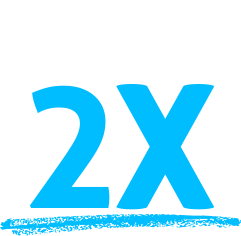
the National Average APY2
Choose Your Term
7 to 13-Month CD

Limited-time offer, external funds required1
12-Month CD National Average

As of May 18, 20262
That's the Power of Local
1 Annual Percentage Yield (APY) of 4.00% for a 7 to 13-month certificate of deposit term for external funds not currently deposited at Citizens National Bank. You may choose a term between 7 and 13 months and earn the stated 4.00% APY. For terms 7 to 11 months, interest is paid at maturity. For terms 12 months and greater, interest is paid quarterly. Offers are accurate as of June 12, 2026, and are subject to change at any time. A $2,500 minimum balance is required to earn stated yield. Available for personal and business money only. Not available to other financial institutions, public entities or brokered deposits. Substantial penalty for early withdrawal. Fees may reduce earnings. CD will automatically renew upon maturity at the rate and APY in effect at the time of renewal.
2 With Citizens National Bank’s 7 to 13-month CD, you can earn more than two times the national average APY of 1.55% for a FDIC National Rate 12-month CD as of May 18, 2026.
Your deposits are FDIC-insured up to the maximum amount allowed by law.
How Much Can You Earn?
Your estimated total earnings
YOUR STARTING BALANCE: $0
ESTIMATED EARNINGS: $0.00
Disclaimer: When working with the calculator, please remember the dollar amounts displayed aren’t guaranteed. The estimates you receive are for illustrative and educational purposes only. This calculator is not intended to offer any tax, legal, or financial advice and does not guarantee your eligibility for any specific product(s).
Have a Banker Contact You
Frequently Asked Questions
What is a CD?
A CD, or Certificate of Deposit, is a type of savings account offered by banks and credit unions that holds a fixed amount of money for a fixed period of time — ranging from a few months to several years — and, in return, pays interest at a fixed rate. Once the term ends, called the “maturity date,” you can withdraw your original deposit plus the interest earned. However, withdrawing funds before the maturity date usually incurs a penalty.
How do bank CDs work?
A bank CD, or Certificate of Deposit, is a time-based savings product that offers a fixed interest rate in exchange for keeping your money deposited for a specific period. Here’s how it works, based on the most relevant and up-to-date information from financial sources:
- Fixed Term and Interest Rate
When you open a CD, you agree to deposit a certain amount of money for a set term — commonly ranging from 3 months to 5 years. In return, the bank pays you a fixed annual percentage yield (APY), which is often higher than what you would earn in a regular savings account. - No Access During the Term
You typically cannot withdraw your money before the CD matures without incurring a penalty. This makes CDs less liquid than other savings options. - Maturity and Renewal
At the end of the term, called the “maturity date,” you can withdraw your original deposit plus the interest earned. Some banks automatically renew the CD unless you provide other instructions. - Safety
CDs are generally insured by the FDIC (for banks) or NCUA (for credit unions), making them a low-risk investment.
What are the benefits of investing in a CD?
Investing in a Certificate of Deposit (CD) offers several compelling benefits, especially for individuals seeking a low-risk, predictable savings option. Based on the most recent financial insights, here are the key advantages:
- Guaranteed Returns
CDs offer fixed interest rates for the duration of the term. This means you know exactly how much you’ll earn by the end of the period. For example, a $10,000 deposit in a one-year CD with a 3.00% APY will yield $300 in interest — no surprises. - Low Risk and FDIC Insurance
CDs are guaranteed up to $250,000 per depositor, per institution, by the FDIC. This makes banks one of the safest places to park your money, especially during uncertain economic times. - Higher Interest Rates Than Regular Savings
CDs typically offer higher interest rates than standard savings or money market accounts, particularly for longer terms. This makes them attractive for those who can afford to lock away funds for a set period of time. - Discipline and Predictability
Because early withdrawals usually incur penalties, CDs encourage disciplined saving. CDs are ideal for short to medium-term goals where you don’t need immediate access to funds. - Variety of Terms
You can choose from a range of CD terms tailored to different financial goals and risk tolerances.
How often is interest paid on CDs?
Interest on bank CDs is typically compounded and credited on a regular schedule, though the exact frequency can vary depending on the financial institution and the specific CD product.
Common Interest Payment Frequencies
- Monthly
Many CDs compound and credit interest monthly. This is common for both short and long-term CDs and allows for more frequent compounding, which slightly increases your total return. - Daily Compounding
Some CDs compound interest daily but still credit it monthly or quarterly. This method maximizes the effect of compounding over time. - Quarterly or Annually
Although less common, some CDs credit interest quarterly or annually. This is more common for longer-term CDs or those with special terms. - At Maturity
For short-term CDs (six months or less in term), interest may be compounded regularly, but is only paid out at the end of the term.
Key Terms to Know
- APY (Annual Percentage Yield) reflects the total interest you’ll earn in a year, including the effects of compounding.
- Simple Interest is calculated only on the principal, while compound interest includes interest on both the principal and previously earned interest.
Can I withdraw my money before the CD matures?
- At Maturity (No Penalty)
When your CD reaches its maturity date — the end of its fixed term — you can withdraw your full deposit plus any interest earned without penalty. Most institutions offer a grace period (typically 7-10 days) after maturity, during which you can:
- Withdraw funds
- Renew the CD
- Transfer the money to another account
- Before Maturity (Early Withdrawal Penalty)
If you withdraw funds before the CD matures, you’ll usually face an early withdrawal penalty. This penalty is often calculated as a set number of days’ or months’ worth of interest, depending on the CD’s term length. In some cases, the penalty may reduce your principal if the interest isn’t enough to cover it.
Your money is safe.
At Citizens National Bank, your peace of mind is backed by more than 138 years of strength, dedicated service, and FDIC protection. We’re committed to helping you grow and safeguard your finances with secure, dependable banking you can trust.